Vehicle sounds (the truck)
Audio in DyingStar explains positional sound, the five knobs on every slot, and the file rules (mp3/ogg, trim the silence). This page is just where the truck's sounds are and what each one is.
A vehicle's sounds are set on the Vehicle node (the truck's root), in the Audio SFX group of
the Inspector. Every slot is optional (empty = silent). Sounds play on the clients, driven by the
truck's replicated state — so a horn, a door or an engine you hear is the same event every nearby
player hears.
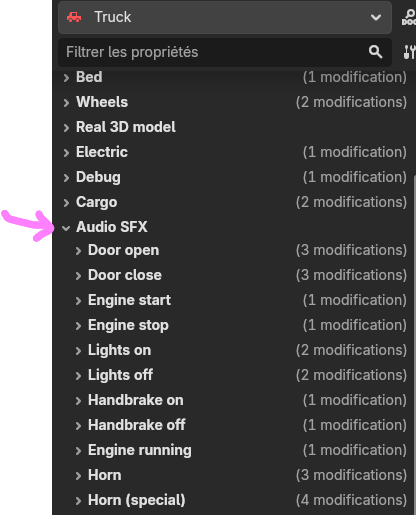
The slots
| Slot | Kind | When it plays | Default attenuation |
|---|---|---|---|
| Door open / Door close | one-shot | a door opens / closes | VERY_SHORT |
| Engine start / Engine stop | one-shot | the engine is turned on / off | REALISTIC |
| Engine running | loop | held while the engine runs (idle → redline) | REALISTIC |
| Lights on / Lights off | one-shot | headlights toggled | VERY_SHORT |
| Handbrake on / Handbrake off | one-shot | handbrake set / released | VERY_SHORT |
| Horn | held loop | held while the horn button is pressed | FAR_REACHING |
| Horn (special) | one-shot | the special horn | FAR_REACHING |
| Tyre scrub | held loop | held while the wheel is turned, below the crossover speed | VERY_SHORT |
| Tyre roll | held loop | held while the vehicle moves, turning or not | VERY_SHORT |
Each has the usual Db / Falloff / Distance / Attenuation knobs. Horns default to FAR_REACHING
so they carry across the map; the engine uses REALISTIC; the small clicks use VERY_SHORT.
The engine loop — one idle sample covers everything
You only record one steady idle loop for Engine running. The game holds it while the engine is on and, as the RPM rises, raises its pitch and volume — so a single sample plays idle through full throttle. It's held back until the Engine start (cranking) clip finishes, then fades in. Three knobs shape it:
- Engine Rev Pitch — the maximum pitch multiplier at the redline (e.g.
2.0= twice as high). - Engine Rev Db — extra volume (dB) added at the redline.
- Engine Rev Response — how quickly the note chases the RPM (the engine's "inertia").
The Horn is a held loop too, with Horn Min Secs (a minimum honk length even on a quick tap) and Horn Fade Secs (a short release fade so it doesn't click when you let go).
For Engine running and Horn, don't worry about the Loop import flag in Godot — the game forces looping on at runtime. Just make sure the clip loops seamlessly (no gap or click at the seams). See the intro's looping note.
The tyres — two sounds, two unrelated questions
They are easy to confuse and they are gated on different things:
| Gated on | Behaviour | |
|---|---|---|
| Scrub | the steering rate | Holding full lock is silent; turning is what scuffs. It stands down once the roll reaches full level. |
| Roll | the speed alone | Its level rises from a standstill to full at Sfx Wheel Roll Kmh, then holds. Turning has nothing to do with it. |
Both are held loops, never a stream of one-shots: a sample longer than the gap between two shots piles onto the tail of the one before, and a single turn ends up sounding like a crowd.
The scrub draws from a SurfaceSounds set, so it changes with what the tyre is
standing on. The roll is a single clip — see that page for why only one of the two asks the surface.
| Setting | What it does |
|---|---|
Sfx Wheel Scrub Min Rate | How fast the steering must turn (rad/s) before a tyre is heard. Too low and it hisses at every trim of the line. |
Sfx Wheel Roll Kmh | The speed at which the roll reaches full volume. It is a ramp, not a switch: below it the sound rises with the speed. |
Sfx Wheel Roll Attack Secs | A slew limiter on that ramp, not a fade-in. It only bites when the speed jumps — a vehicle spawning mid-drive, or landing. |
Sfx Wheel Scrub Fade Secs | How fast both die once their condition stops. Deliberately short: a tyre sound that outlives the movement is heard as a sound that forgot to stop. |
What's replicated
The truck replicates the state that drives its sounds (engine on/off, handbrake, headlights, the doors map, the held-horn bool, and a special-horn counter), and each client plays the matching sound from it. The engine loop's pitch/volume are derived locally from the replicated speed, so no audio stream is ever sent over the network. (For the networking side, see the developer page Adding a vehicle.)